Project / 07
Loomline
A shared catalogue for materials and makers.
- Category
- Concept · Platforms · Archives
- Year
- 2025
- Role
- Founder
- Status
- Fictional concept placeholder
Premise
Keep material knowledge attached to the sample.
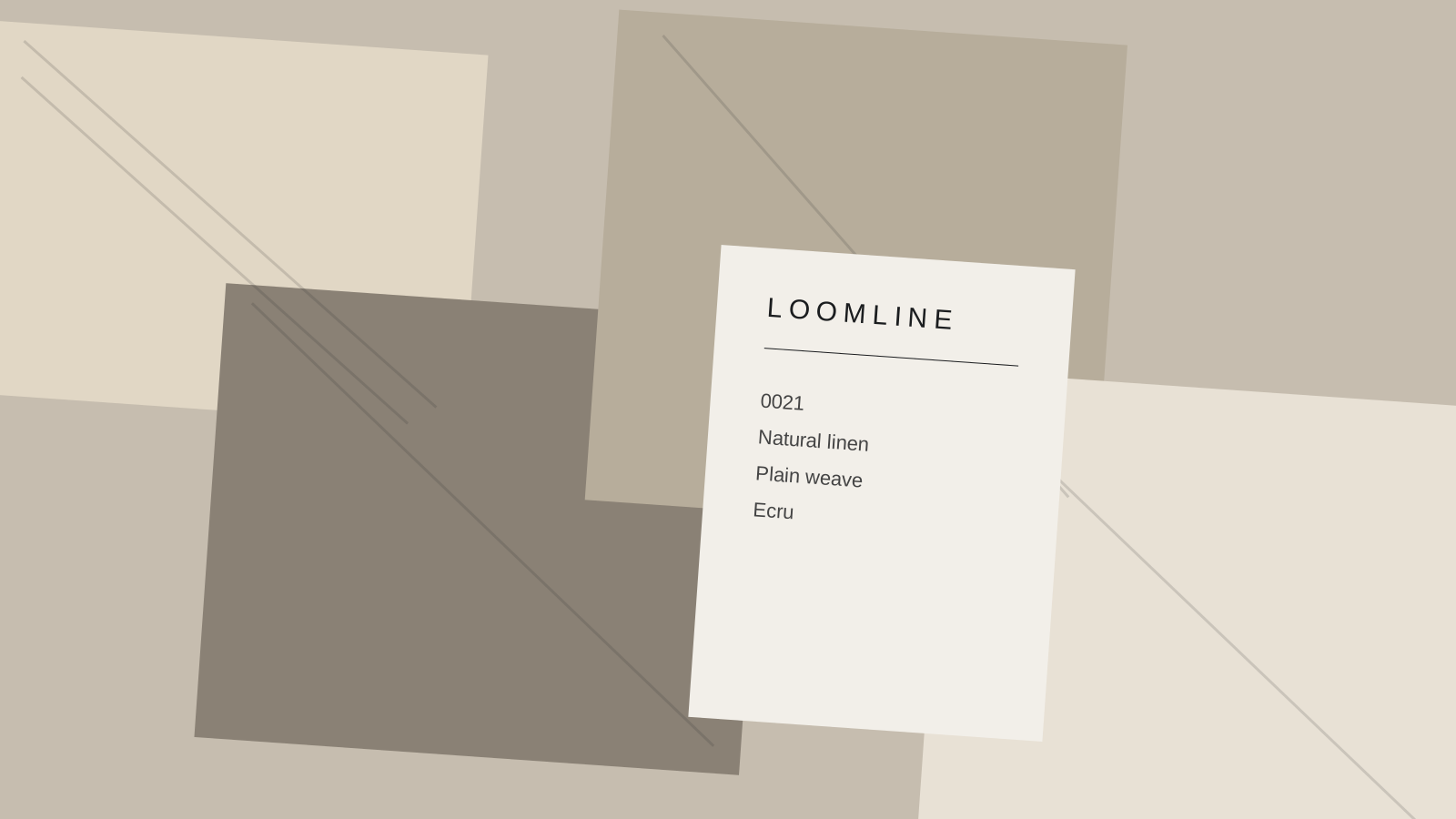
Loomline is a fictional exploration of how makers might record where a material came from, how it behaves, and what they learned while using it.
The catalogue treats the sample as the starting point and keeps source notes close enough to compare.
Interaction
From sample to shared note.
Capture
Photograph the sample in consistent light.
Describe
Record feel, finish, weight, and weave.
Source
Attach supplier and provenance notes.
Compare
Place related materials side by side.
Share
Pass a concise record to another maker.
System
A catalogue built around evidence.
This diagram describes the fictional information model only.
Sample
- Photograph
- Material
- Finish
Source
- Maker
- Supplier
- Place
Observation
- Use
- Wear
- Care
- Identity
- One record represents one physical sample.
- Comparison
- Shared fields make different samples easier to scan.
Tradeoffs
Consistency has a cost.
| Constraint | Choice | Consequence |
|---|---|---|
| Uneven source data | Allow partial provenance | More records with less certainty |
| Different vocabularies | Use a small shared glossary | Clearer comparison with less nuance |
| Image variation | Provide a capture guide | More consistent records with extra effort |
| Sensitive suppliers | Make sharing explicit | Better control with more decisions |
Retrospective
Where the catalogue becomes too rigid.
Fields are not knowledge
Useful observations often arrive as stories rather than tidy attributes.
A photograph can mislead
Texture, weight, and drape are difficult to understand through a screen.
Provenance changes
A source record needs a visible history without turning into administration.
Code evidence
A sample record as pseudocode.
sample
  identity: one physical swatch
  source: maker and place
  observations: use, wear, care
sharing: private until chosenStill unresolved
Questions for another prototype.
Touch
What can a digital record communicate about physical feel?
Language
How can personal material vocabulary remain useful to others?
Ownership
Who should be able to revise a shared source record?