
Project / 04
Opportunity Desk
An installable, local-first workspace for finding opportunities and tracking applications from discovery to follow-up.
- Category
- Web · PWA
- Year
- 2026
- Role
- Creator
- Status
- Live PWA
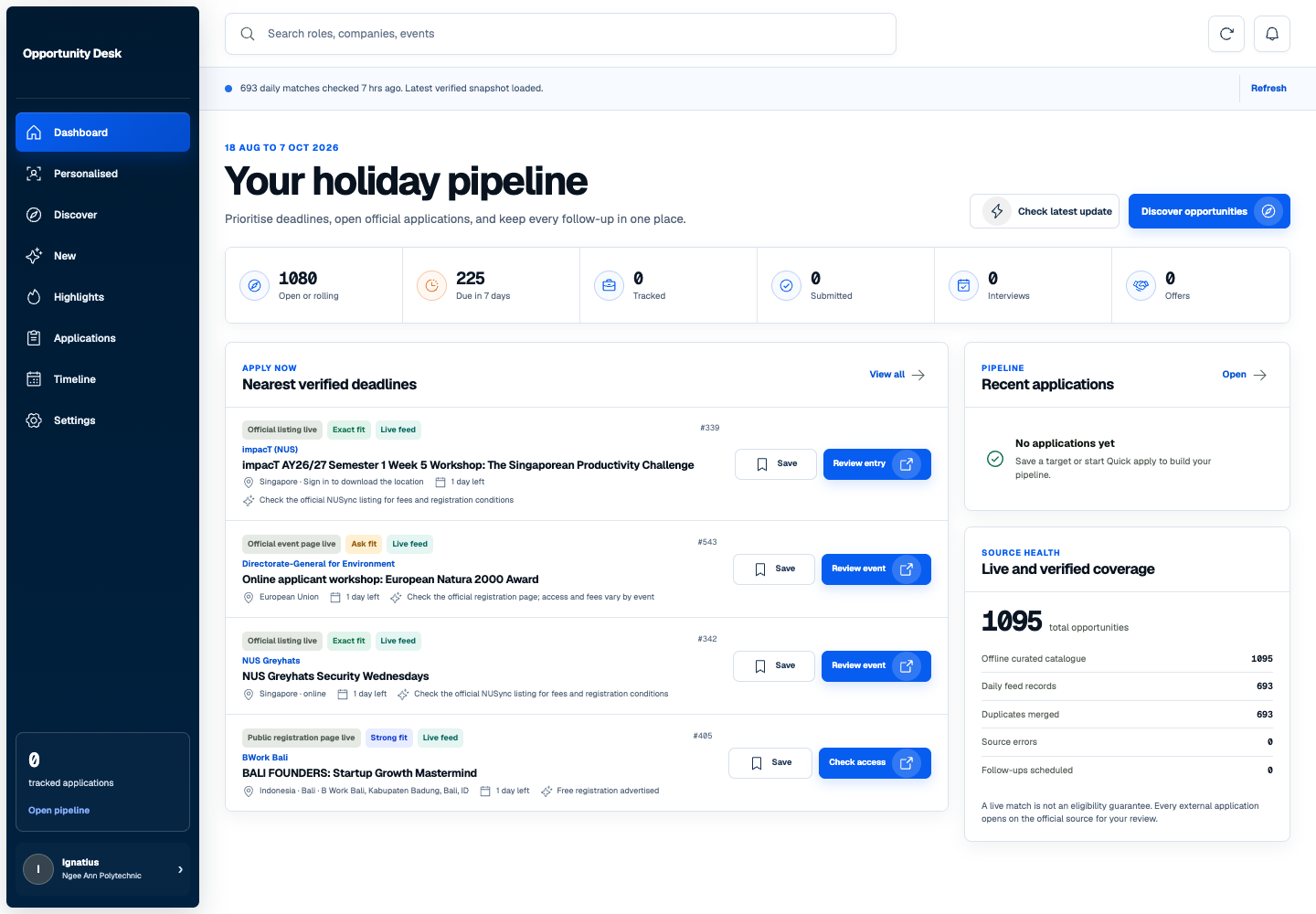
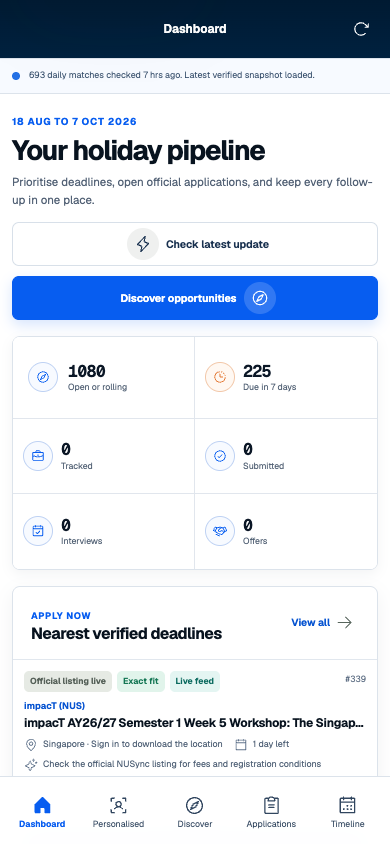
Inside the product
Open a screen for a closer look.
Premise
Turn scattered opportunities into a working pipeline.
Opportunity Desk combines a manually reviewed catalogue with a generated daily snapshot from official and public sources.
Discovery, eligibility caveats, application preparation, notes, follow-ups, and reminders live in one installable workspace without sending personal application data to a server.
Interaction
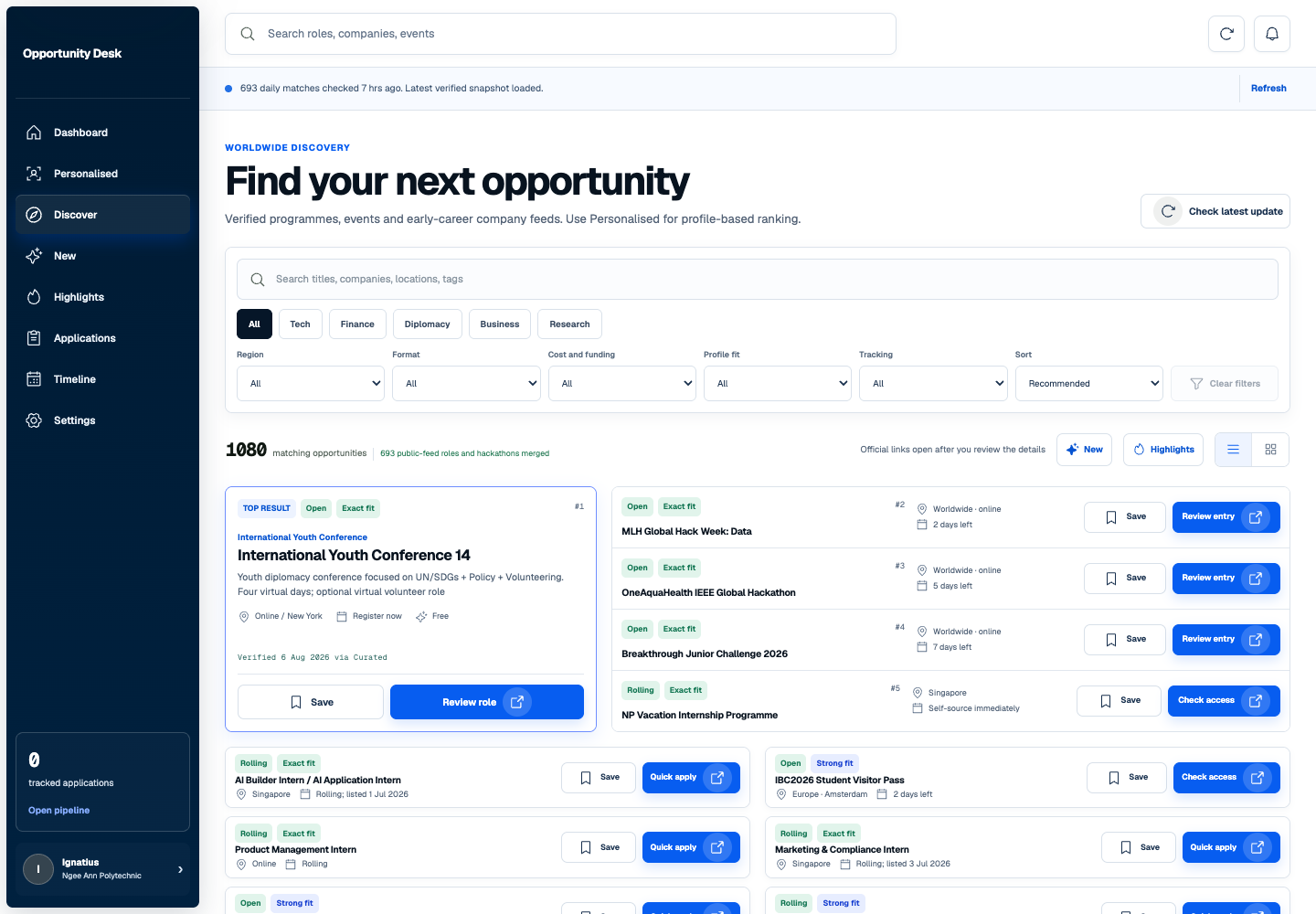
Discovery leads into an explicit application record.
Discover
Search and filter by category, region, format, funding, fit, and tracking state.
Verify
Read the official source, verification date, eligibility caveat, and closure timing.
Prepare
Quick apply creates a local record, checklist, and tailored opening paragraph.
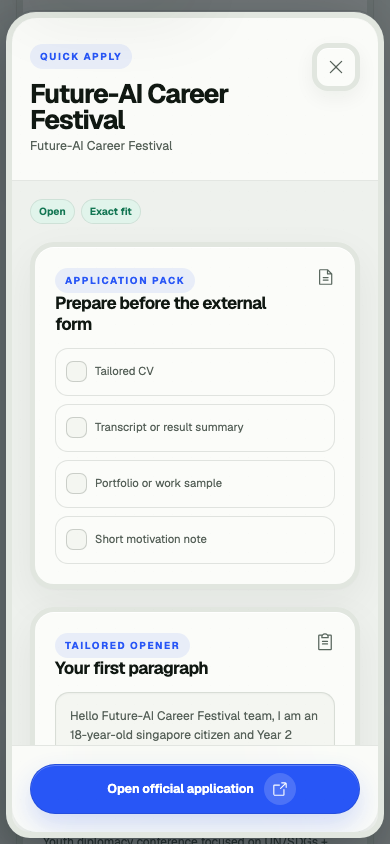
Quick Apply prepares the application but leaves submission on the official site. Track
Move the application through supported stages and add private notes.
Follow up
Use reminders, timeline history, and JSON backup to keep the process intact.
System
A static PWA with a cloud-built research layer.
The deployed browser receives a validated snapshot. Crawling and source research run in bounded GitHub workflows rather than inside the client.
Research
- Official APIs
- Public structured events
- Curated records
- Expiry checks
Catalogue
- Zod contract
- Stable identity merge
- Source diagnostics
- Lifecycle filtering
Workspace
- Next.js PWA
- Local application state
- Offline shell
- Backup and import
- Data ownership
- Applications, notes, reminders, and profile settings remain in the browser unless the user exports a backup.
- Safe handoff
- External applications open on verified HTTPS pages after the local preparation record is saved.
Decisions
Automation stops before personal submission.
| Decision | Implementation | Boundary |
|---|---|---|
| Quick Apply | Checklist and draft opener | No third-party form is submitted automatically |
| Persistence | Versioned local browser state | No cross-device synchronization is claimed |
| Live data | Static cloud-built snapshot | The browser does not run crawlers or source adapters |
| Opportunity status | Explicit lifecycle rules | Expired listings leave discovery but remain in application history |
Build notes
The research pipeline is broad, bounded, and evidence-led.
First-party proof
A discovered URL becomes catalogue content only after a live organizer or first-party page provides dated evidence.
Stable tracking
Fresh source data can update a listing without orphaning the application attached to its stable identity.
Offline continuity
The application shell and local mutations continue to work when the network is unavailable.
Still unresolved
Useful additions require new trust boundaries.
Cross-device sync
Synchronization would require authentication, a database, row-level authorization, and a privacy review.
Status ingestion
Automatic employer updates would require explicit email or applicant-tracking authorization.
Coverage
Public sources can be missing, blocked, unstructured, or outside the audited registry, so the catalogue cannot be comprehensive.