
Project / 12
Tally House
A visual archive for everyday collections.
- Category
- Concept · Archives
- Year
- 2024
- Role
- Founder
- Status
- Fictional concept placeholder
Premise
Ordinary objects carry uncommon histories.
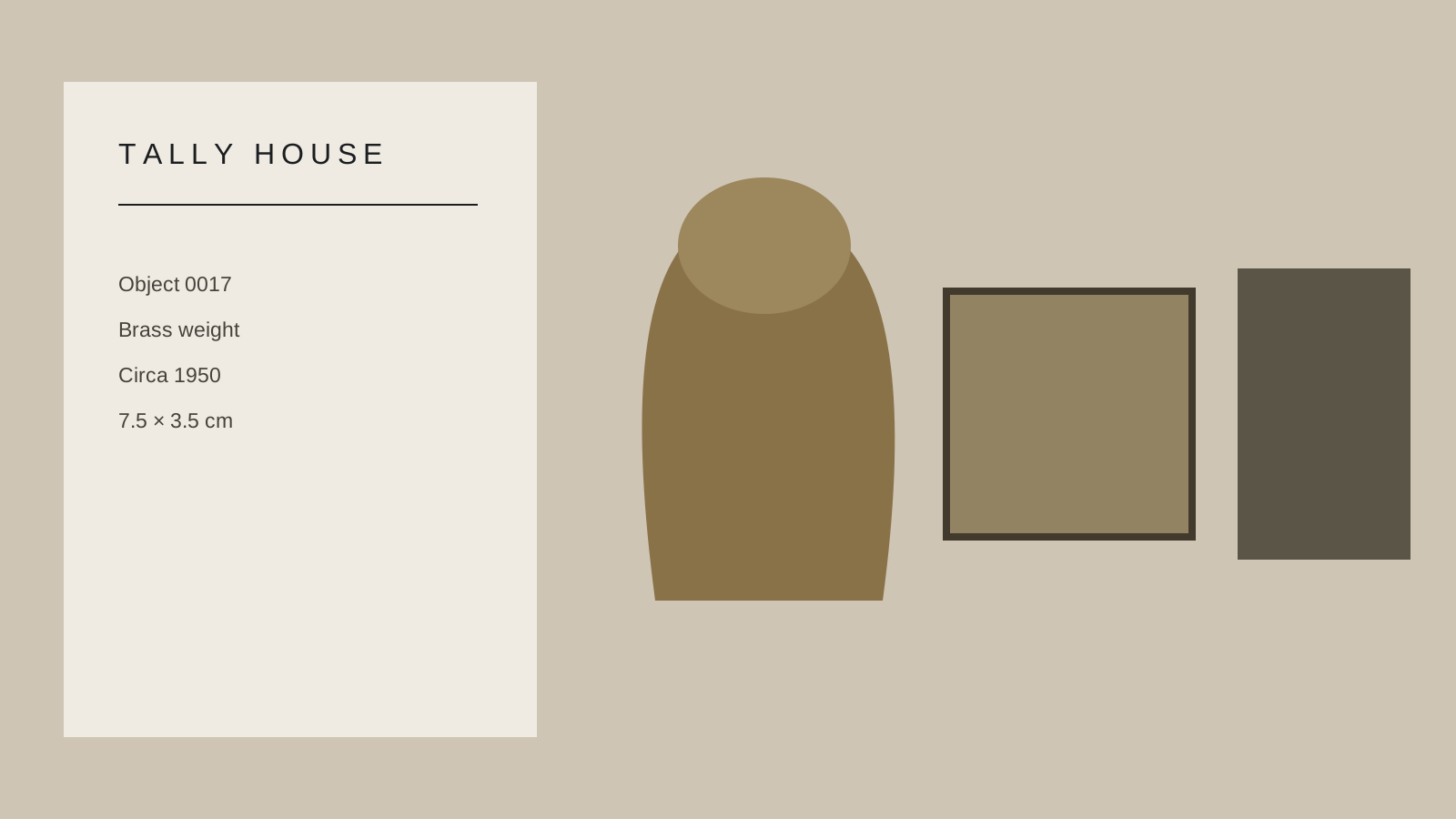
Tally House is a fictional visual archive for recording everyday objects and the personal stories attached to them.
The concept keeps the record deliberately small: one clear image, a few physical facts, and the reason the object matters.
Interaction
A careful capture routine.
Choose
Select one object and one reason to keep it.
Photograph
Use a consistent view and neutral setting.
Measure
Record only useful physical facts.
Remember
Add the personal note that gives it context.
Relate
Connect it to a place, person, or collection.
System
Small records, visible relationships.
This is a fictional archive model rather than a description of a live database.
Object
- Image
- Material
- Dimensions
Story
- Note
- Date
- People
Collection
- Theme
- Place
- Relationship
- Record
- Each object can stand alone without requiring a collection.
- Relation
- Connections remain descriptive rather than hierarchical.
Tradeoffs
An archive always edits the story.
| Constraint | Choice | Consequence |
|---|---|---|
| Time to record | Five required fields | Lower friction with less detail |
| Visual consistency | One capture guide | Clearer browsing with less spontaneity |
| Personal context | Private by default | More safety with fewer shared discoveries |
| Changing memories | Editable notes | Living records with less permanence |
Retrospective
Cataloguing can flatten what matters.
Facts are not significance
Measurements describe the object but rarely explain why someone kept it.
Consistency can remove character
A neutral photograph may hide the setting that made the object memorable.
Completion is the wrong goal
A personal archive should support attention, not demand exhaustive documentation.
Code evidence
The smallest useful record.
object
  image: one clear view
  facts: material and size
  note: why it matters
  relationships: optional
visibility: privateStill unresolved
Questions the archive leaves open.
Inheritance
How should a record change when an object moves to someone else?
Absence
Can the archive hold a useful memory after the object is gone?
Sharing
Which stories belong to the owner, and which include other people?